

Panda Fortune Rush by BGaming and Playzia: How Cluster Pays, Scatter Bar and Multipliers Work Together
Panda Fortune Rush is a 2026 slot developed by BGaming in collaboration with Playzia and released on 19 February 2026. Instead of relying on conventional paylines, the game places its symbols on a large 7×7 grid and makes the number of matching symbols far more important than their position on a fixed line. BGaming describes the central system as Cluster Pays, while the practical rules are also commonly described as pay-anywhere or Scatter Pays because qualifying symbols can contribute across the grid. The slot combines this counting-based payout structure with a Scatter Bar, Free Spins and Surprise Multipliers of up to ×50. These elements are not separate extras added around a conventional slot engine: they are designed to affect one another. The grid determines whether enough matching symbols have landed, the Scatter Bar monitors the bonus-triggering Scatters, and the multiplier system can increase the value of qualifying regular-symbol wins. Understanding that relationship makes Panda Fortune Rush considerably easier to read than its busy 49-position layout might initially suggest.
How the 7×7 Cluster Pays Grid Builds Wins
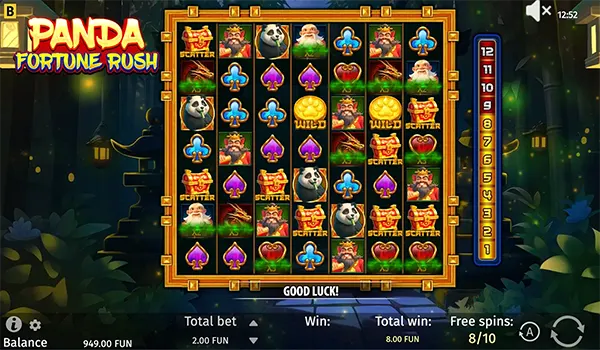
Panda Fortune Rush uses seven reels and seven rows, creating 49 visible positions on every spin. That is significantly more screen space than a standard five-reel slot, but players do not need to trace dozens of paylines across it. The game evaluates how many matching symbols are present and awards a payout when the required quantity is reached. Published game information places the starting threshold at 12 matching regular symbols, so a small group of three, four or five matching icons is not enough. Larger quantities generally correspond to higher values in the paytable. This arrangement makes every part of the grid relevant and shifts attention away from whether a symbol landed on the first, third or fifth reel. When the reels settle, the main question is simply whether enough examples of the same symbol have appeared to form a paying result.
BGaming’s own release material uses the term Cluster Pays, although Panda Fortune Rush behaves somewhat differently from cluster slots in which matching symbols must touch horizontally or vertically. Several published game descriptions categorise the mechanism as Scatter Pays or pay-anywhere because the payout calculation is primarily based on the total quantity of identical symbols across the 7×7 field. For the player, this distinction is more useful than the terminology itself. There is no need to follow a left-to-right pattern, and a group does not have to resemble a conventional payline. The large grid is therefore not intended to create 49 separate positions that have to be checked manually. It gives the game enough room for comparatively large quantities of one symbol to appear in the same result, which is necessary when the minimum qualifying count begins at 12.
The symbol hierarchy still matters even though position is less restrictive. Panda, dragon and character symbols sit toward the more valuable end of the paytable, while simpler suit-style symbols generally produce lower base payouts. This means that two spins containing the same number of matching symbols can have very different values depending on which symbol has qualified. Wilds can substitute for ordinary paying symbols but do not replace Scatters, keeping the two functions separate. Panda Fortune Rush also does not rely on a long chain of tumbling wins to make its main features work. Each completed spin produces its own arrangement, and the important interaction takes place between the quantity of matching symbols and any multiplier assigned to that symbol type. The result is a comparatively direct system despite the size of the grid.
Why Symbol Count Matters More Than Position
The easiest way to read a Panda Fortune Rush spin is to think in quantities rather than patterns. Suppose a particular regular symbol appears only eight or nine times across the 49 positions. Even if several examples sit next to one another, that quantity remains below the usual 12-symbol starting requirement and therefore does not produce the corresponding count-based payout. If the same symbol appears 12 or more times, the game can evaluate it as a qualifying result. As still more copies appear, the applicable paytable tier can increase. This makes the 7×7 design functional rather than merely decorative: a larger field provides room for the symbol counts needed by the payout system. It also explains why a screen can appear packed with identical icons without necessarily producing an unusually large return, as the actual value still depends on the symbol, its quantity and any active multiplier.
This count-based approach also makes the Surprise Multiplier system particularly relevant. In a conventional payline slot, a multiplier may affect a single line or a defined combination. Here, a multiplier is attached to a regular symbol type selected for that spin. If enough copies of that symbol appear to qualify for a payout, the multiplier can raise the value of the corresponding win. A low-paying symbol can therefore become considerably more significant when it is selected for a strong multiplier and appears in sufficient quantity. The reverse is equally important: receiving a ×50 label does not itself create a payout. If the selected symbol fails to reach a qualifying count, there is no regular-symbol win for the ×50 value to enhance. The multiplier changes the value of a successful result rather than changing a losing arrangement into a winning one.
There is consequently little value in treating individual symbols as if they predict what will happen next. Each spin is a separate random result, and a screen containing many pandas, dragons or Scatters does not make a similar arrangement more likely on the following round. The large grid can make patterns look meaningful because there are so many visible symbols, but the relevant information is contained in the current result and the published paytable. This is also why the game remains reasonably approachable despite using several branded feature names. Players only need to follow three basic pieces of information at once: how many matching regular symbols have landed, which regular symbols have been assigned multipliers, and how many Scatters are present on the current spin. The rest of the interface mainly visualises those calculations.
How the Scatter Bar Leads to Free Spins
The Scatter Bar sits alongside the main grid and gives the Scatter symbol a clearly visible role. Its purpose is to show how many Scatters have appeared in the relevant spin, with 12 or more required to start the Free Spins feature. This detail is important because the bar should not be mistaken for a meter that steadily saves one or two Scatters from spin to spin until a permanent target is reached. The trigger is based on obtaining the required Scatter quantity in a qualifying result. When at least 12 Scatters appear, Panda Fortune Rush awards 10 Free Spins. The high threshold makes more sense when viewed in the context of the 49-position grid: 12 symbols would be excessive on a conventional five-reel layout, whereas the larger field leaves much more room for simultaneous Scatter appearances.
Scatters are also separated from the regular-symbol multiplier system. Surprise Multipliers apply to selected paying symbols rather than to the Scatter or Wild. This prevents the bonus trigger and the regular payout enhancer from becoming the same mechanic. The Scatter Bar is concerned with access to Free Spins, while multipliers are primarily concerned with increasing qualifying regular-symbol wins. They can still influence the same round indirectly. A spin may contain a substantial Scatter count while also producing a multiplied regular-symbol win, but one feature does not automatically increase the other. This separation keeps the interface understandable: the bar on the side answers the question of whether the Free Spins threshold has been reached, while the multiplier labels show which ordinary symbols have extra value on that particular spin.
The game also includes a Buy Bonus option that was specified at ×25 the total bet in the release version, where such a feature is permitted. It provides direct entry to the Free Spins round instead of waiting for the natural 12-Scatter trigger. The relatively low ×25 price compared with many feature-buy slots should not be interpreted as evidence that buying the round is more likely to produce a profit. It simply changes how access to the feature is purchased and places a larger amount at risk at once. Feature Buy availability can also differ between jurisdictions and casino sites because some regulated markets restrict or prohibit this type of mechanic. Players checking Panda Fortune Rush through an operator should therefore rely on the rules displayed in that particular version rather than assuming the button will always be present.
What Changes During the 10 Free Spins
Free Spins retain the same basic 7×7 structure rather than replacing it with a completely different bonus game. The most important change concerns Surprise Multipliers. In the base game, between one and three regular symbol types can receive a random multiplier on each spin. During Free Spins, three regular symbol types receive multipliers on every spin. The possible values remain within the same range, reaching as high as ×50. This means the bonus does not need a new set of reels or an additional jackpot mechanism to alter the mathematical character of a round. It simply makes the existing multiplier feature more consistently present. Three boosted symbol types on every free spin increase the number of situations in which a qualifying symbol count can coincide with an enhanced value, although no particular multiplier or payout is guaranteed.
The multipliers available in Panda Fortune Rush are ×2, ×3, ×5, ×10 and ×50. They are assigned to eligible regular symbols for the relevant spin rather than permanently raising a symbol for the entire session. As a result, each Free Spin needs to be evaluated on its own. A panda might receive a useful multiplier on one round and no multiplier on the next, while a lower-value symbol could receive the strongest available boost instead. This creates variation without requiring complicated persistent meters. The most favourable situations occur when a symbol receives a substantial multiplier and then appears often enough on the 7×7 field to qualify for a worthwhile underlying payout. A high multiplier attached to a symbol that does not reach the required count has no practical effect, so both parts of the result have to align.
Free Spins can also be extended. BGaming’s release information states that further qualifying Scatter appearances can retrigger the feature, and the developer’s promotional material specifies another 10 Free Spins when the 12-Scatter requirement is met again during the bonus. Retriggers matter because each additional spin provides another independent opportunity for three symbols to receive multipliers. They do not make the multipliers accumulate indefinitely or guarantee that the extended feature will outperform the original ten rounds. A retrigger simply increases the number of bonus spins available under the Free Spins rules. This distinction is useful when assessing the feature realistically: additional rounds create more opportunities, but random results still determine whether those opportunities produce low, moderate or unusually strong payouts.
How Surprise Multipliers Change the Value of a Win
Surprise Multipliers are the mechanic most likely to change an otherwise ordinary Panda Fortune Rush result into a noticeably stronger one. In the base game, one, two or three eligible regular symbol types are randomly selected on each spin and assigned a multiplier. Published values are ×2, ×3, ×5, ×10 and ×50. If one of those symbols forms a qualifying win, its applicable prize is enhanced by the assigned multiplier. This creates two layers to every result: first the 7×7 grid must contain enough matching symbols to create the underlying payout, and then the game checks whether that symbol was among those selected for a multiplier. The process is easy to follow visually because the game identifies the boosted symbols before the final value is settled, allowing players to see why two superficially similar symbol counts can return very different amounts.
The ×50 multiplier naturally attracts attention, but its presence should be interpreted carefully. It represents the highest individual Surprise Multiplier value, not a guaranteed ×50 return on the stake and not the same thing as the game’s maximum win. The underlying symbol must still produce a qualifying payout for the multiplier to matter. A large payout therefore depends on several conditions occurring together: the right regular symbol must be selected, a strong multiplier must be assigned, and enough copies of that symbol must land to reach a valuable paytable tier. During Free Spins, having three multiplied symbol types on every round increases the number of potentially useful combinations, but the same basic requirement remains. A multiplier enhances a win that has already qualified; it does not remove the random nature of the grid.
This relationship explains why Cluster Pays, the Scatter Bar and multipliers feel connected even though their formal jobs are different. Cluster Pays determines which regular-symbol quantities are payable. Surprise Multipliers can increase those regular-symbol payouts. The Scatter Bar looks for the separate 12-Scatter condition that moves play into a feature where three regular symbols are guaranteed to receive multipliers on every spin. The Scatter mechanic therefore acts as a route into a version of the game with more consistent multiplier activity, rather than serving as a multiplier itself. Panda Fortune Rush consequently builds most of its variation from a relatively small group of rules. It does not need many unrelated bonus screens because the same mechanics change importance depending on whether the player is in the base game or Free Spins.
RTP, Volatility and What the Numbers Mean
Panda Fortune Rush is generally listed with a default theoretical RTP of 96.03%, medium volatility and a maximum win of 1,750× the total stake. These figures describe different parts of the mathematical model and should not be read as predictions for an individual session. RTP is a long-term theoretical percentage calculated across a very large number of game rounds; it does not mean that a player staking £100 should expect £96.03 back during one sitting. Medium volatility describes the intended distribution of results rather than guaranteeing frequent wins of a particular size. The 1,750× figure is a maximum payout ceiling, not a target that the game is expected to approach regularly. Players should also check the information panel in the version they are using because RTP configurations and feature availability can sometimes differ between operators or regulated markets.
The medium-volatility model fits the way the mechanics are arranged. Panda Fortune Rush does not rely solely on a rare bonus with an extremely large maximum prize. Instead, random multipliers are present during ordinary play, while Free Spins increase their consistency by assigning them to three symbols on every spin. At the same time, the 1,750× maximum win is relatively restrained compared with slots designed around five-figure or substantially higher stake multipliers. That does not make smaller results predictable, nor does it reduce the importance of setting spending limits. The ×25 Buy Bonus can consume a session budget much faster than ordinary individual spins because a much larger multiple of the stake is committed immediately. Changing the route into Free Spins does not remove the house advantage or make a positive return certain.
There is one further 2026 detail worth knowing before looking for the game. Panda Fortune Rush was released by BGaming on 19 February 2026 as a collaboration with Playzia, but BGaming’s current official game page now marks the title as archived and unavailable. Its release announcement and published game information still document the 7×7 layout, Cluster Pays, 12-Scatter Free Spins, multipliers of up to ×50 and the ×25 Buy Bonus, so the mechanics of the released version remain clear. The archived status does mean that availability should not be assumed simply because an older casino catalogue or review still lists the slot. From a gameplay perspective, Panda Fortune Rush is best understood as a count-based grid game in which the Scatter Bar provides access to a multiplier-heavy Free Spins round, while Surprise Multipliers determine how valuable qualifying regular-symbol results can become.
-
news
 Eastern Fury by Pragmatic Play: How Expanding Wilds and Growing Mul...
Eastern Fury is a Pragmatic Play slot released on 27 August 2026, built around a 5×5 …
-
news
Panda Fortune Rush by BGaming and Playzia: How Cluster Pays, Scatte...
Panda Fortune Rush is a 2026 slot developed by BGaming in collaboration with Playzia and released …
-
news
 Bao Shi Slot Review: Lioras, Gong Free Spins and Chinese Lion Lore
Released by Play’n GO in October 2025, Bao Shi is a five-reel slot set among misty …